Last Updated on December 19, 2025
Bringing traffic to a website or e-Commerce store has never been simple. And with so many new AI developments, it’s maddening to find what to focus on. AI overviews in search results and ChatGPT’s direct answers to questions have made it tough to grow site traffic, even with umpteen search optimisations. So, is SEO dead with AI?
Well, even if it has become more difficult to attract search traffic, the truth is that organic SEO is not dead. Now, it’s more like transforming into something bigger. From traditional search, SEO has widened to include AI platforms and Generative Engine Optimisation (GEO).
In this article, we’re exploring why SEO is not dead even after the hyper-growth of ChatGPT. We’ll discuss what’s happening in AI search and why Google SEO is even more important.
Let’s dive in.
Table of Contents
Google still matters more than ever in 2026
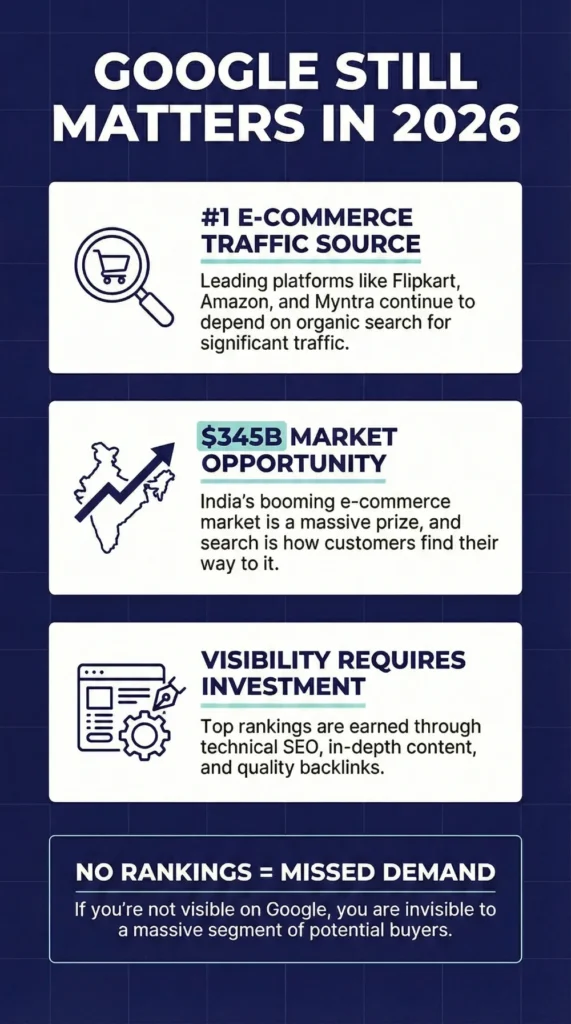
Flipkart, Amazon India, Myntra, Meesho and many other major Indian e-commerce platforms rank among India’s most visited websites. These shopping platforms and other sites receive substantial organic traffic, with Google being the #1 referral traffic source. This indicates Google SEO remains a critical acquisition channel even in this age of AI.
Also Read: The Ultimate Playbook to Win the Buy Box on Amazon
Even though zero-click Google searches are rising (due to AI overviews), about half of searches still result in clicks to organic results. Also, India’s e-commerce market is projected to reach $345 billion by 2030, and guess what remains the primary discovery channel? Google.
Google’s dominance isn’t fading; it’s expanding into new formats. Technical SEO, content depth, and relevant backlinks continue to shape which brands get seen.
The internet landscape is also undergoing a transformation, with a projected user base of over 900 million. And if your website isn’t ranking, you’re missing out on a massive audience actively looking for what you offer. So, you need to continue working on SEO even after AI.
[Case Study] Transforming Blog Readers into Customers – From Clicks to Sales
ChatGPT is changing discovery, not replacing search
 It’s true that ChatGPT is also driving measurable referral traffic to websites. This traffic, although modest, is growing. Then, OpenAI’s Instant Checkout feature allows users to make purchases directly within ChatGPT conversations.
But here’s the reality: ChatGPT doesn’t have independent, real-time web access (suggested by an acme.bot experiment). Both the paid and free logged-in versions of ChatGPT use Google. It’s built on top of traditional search infrastructure, not replacing it. So, ChatGPT search is currently an extension of the search ecosystem, not a competitor.
And the referral ChatGPT traffic is dramatically smaller than Google’s organic search traffic. Now, that doesn’t mean we can ignore ChatGPT. It has seen a 25% rise in shopping-related AI prompts, signalling that generative commerce will grow steadily in the coming years. As Instant Checkout grows, the number of transactions on ChatGPT could skyrocket.
Also Read: How to Enable Instant Checkout on ChatGPT for Shopify
Still, if you’re ranking well on Google, you’re well-positioned to benefit from ChatGPT’s growth. If you aren’t, you’re invisible on both platforms. ChatGPT expands your discovery footprint; it doesn’t replace the need for search visibility.
AI engines still rely on traditional search signals
Whether you’re using ChatGPT, Perplexity or any other generative AI engine, they all operate in the same way as conventional search. These AI tools favour website reputation and authority, just like Google. They pull their results from authoritative, structured websites.
Also Read: 11 Practical Use Cases of Manus AI in Marketing
That’s where SEO fundamentals come in. SEO isn’t dead. Websites with strong E-E-A-T (experience, expertise, authoritativeness, trustworthiness) signals are more likely to appear in AI-generated answers and citations.
In Google AI overviews, 70% of the sources come from the top 10 organic results. It builds on what its ranking algorithm already considers “high-quality.”
The brands winning in AI-generated answers are the same ones winning in SERPs (search engine result pages). Well-structured data, in-depth content, and original research make your site more likely to be referenced by AI systems.
Community trust and backlinks matter more than ever
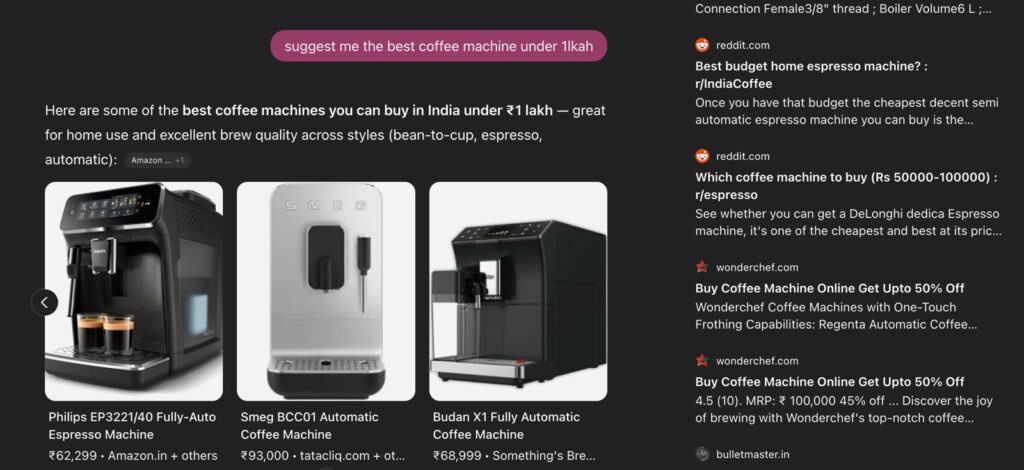
ChatGPT recognized the reddit product mentions for Coffee Machine
Beyond traditional link-building, product mentions in trusted communities act as “demand signals” that algorithms recognise and reward. Relevant backlinks remain one of the top-ranking signals for search engines. Answer Engine Optimisation (AEO) for AI search engines, too, blends institutional authority with community insight.
Reddit, Quora and niche forums don’t just influence human buying decisions. They’re also shaping AI training data and influencing what gets cited in AI-generated responses. And Google’s licensing deal with Reddit underscores how valuable community-generated content has become.
Also Read: Integrate WhatsApp with ChatGPT for Automated FAQ Responses
When someone recommends your product in a Reddit post, that signal ripples. It builds trust with potential customers, strengthens your backlink profile, and improves your E-E-A-T signals. Plus, it increases the likelihood that AI systems will reference your brand.
Thus, community trust plus quality backlinks equals SEO and AEO growth. Brands with an authentic community presence see higher visibility in both search results and AI citations.
GEO builds on SEO for Generative era
Now, you may have seen people announcing “SEO is dead; long live GEO.” However, it’s a half-truth. Generative Engine Optimisation (GEO) just indicates a shift from traditional SEO practices. Similar to AEO, it builds on top of SEO.
GEO is about optimising your brand/website visibility inside comprehensive AI-generated answers. And the fundamentals remain the same. High-quality, authoritative content still matters. Schema markup and structured data remain essential. Plus, an E-E-A-T-driven content strategy with in-depth topical coverage works for both traditional search and AI platforms.
Mastering How to Use ChatGPT for E-commerce Sales: Online Pharmacy Success Story
[Case Study] Bringing New Parents Through Parent Focused E-commerce SEO
What changes with GEO is the format and intent. Instead of optimising only for keyword-focused search rankings, you now have to consider conversational, natural language queries. Success is measured by “AI share of voice” across generative engines, i.e., how often you appear in relevant AI responses compared to competitors.
GEO is simply SEO rewritten for a world where discovery happens across multiple AI engines, not just search engines. Keep creating valuable, helpful, trustworthy content, and you’ll be rewarded with visibility. This visibility can come from a Google result or a ChatGPT citation.
Build Your AI SEO Strategy with Blusteak
So, is SEO dead now? In traditional terms, yes, SEO is dead; start AEO and GEO. However, keep in mind that these are just extensions of SEO. If you’re doing website SEO right, you’re already halfway to winning in the AI era.
At Blusteak, we help businesses build AI-first online presence. We strengthen SEO fundamentals while optimising websites for AI platforms and generative engines.
Want to build an AI SEO website strategy? Get in touch with Blusteak