Last Updated on October 6, 2026
ChatGPT Ads launched in India in late August 2026, when OpenAI opened self-serve access to Indian advertisers. If you’ve started poking around ChatGPT Ads Manager since then, you’ve probably noticed how it’s different from Google or Meta advertising.
The targeting model works differently here, because ChatGPT users aren’t typing search fragments. So, the Ads Manager doesn’t have the keyword box or the interest-based audience picker. ChatGPT Ads primarily show ads via Context Hints.
In this article, we’re giving a walkthrough of ChatGPT Ads Context Hints. You’ll understand how to use OpenAI’s ad system to tell when your ad might actually belong in a conversation.
Let’s dive in.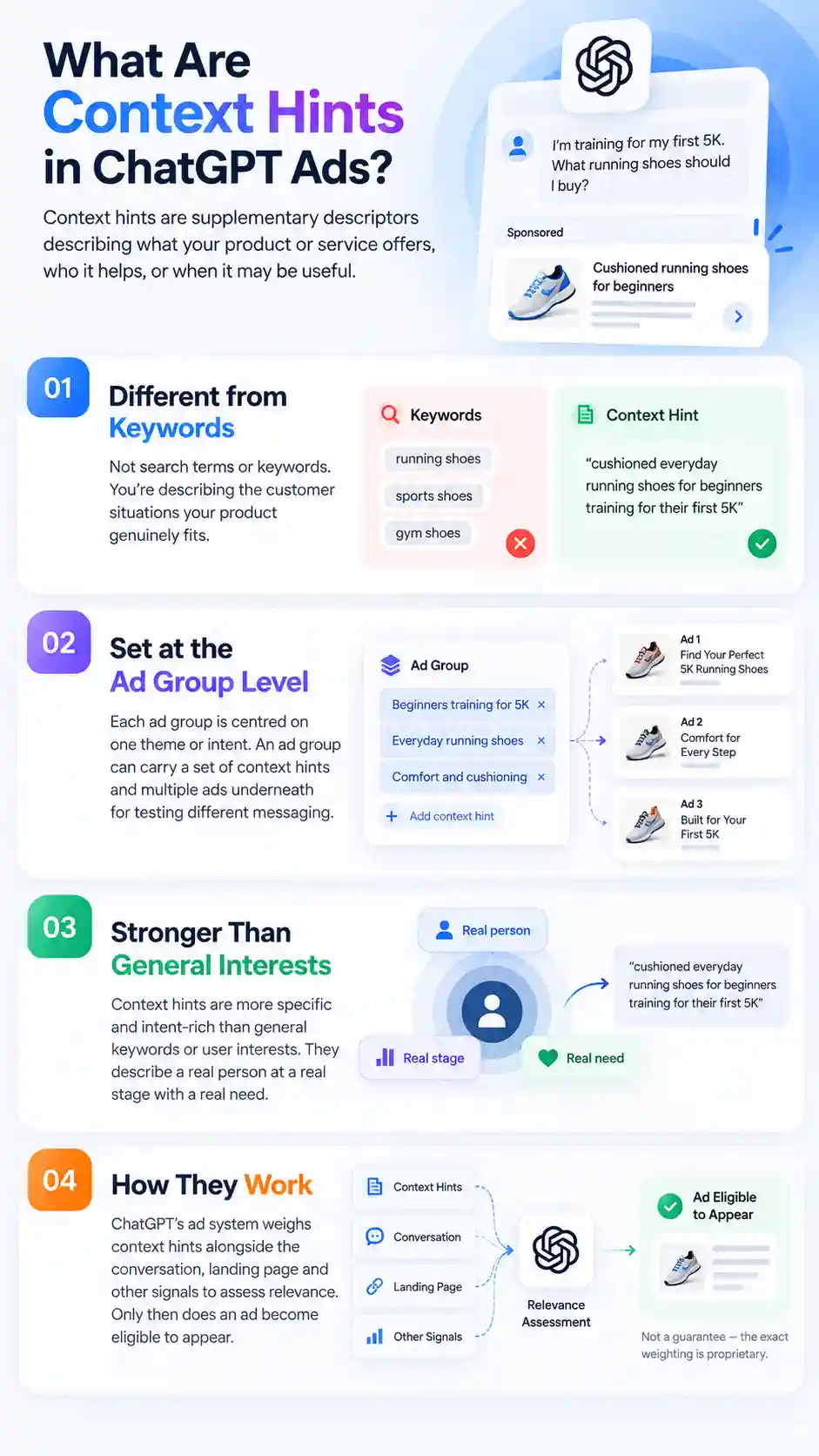
Table of Contents
What Are Context Hints in ChatGPT Ads?
As per OpenAI, context hints are supplementary descriptors describing what your product or service offers, who it helps, or when it may be useful. It’s different from search terms or keywords in the sense that you’re describing the customer situations your product genuinely fits.
These context hints are set at the ad group level, each centred on one theme or intent. An ad group can carry a set of context hints and multiple ads underneath for testing different messaging.
And these hints are stronger than general keywords or user interests. For example, a hint such as “cushioned everyday running shoes for beginners training for their first 5K” describes a real person at a real stage with a real need.
ChatGPT’s ad system weighs those hints alongside the conversation, landing page and other signals to assess relevance. Only then does an ad become eligible to appear. It’s never a guarantee, though, as the exact weighting behind OpenAI’s matching stays proprietary.
Also Read: How to Enable ChatGPT Instant Checkout for Shopify
Context Hints vs. Keywords
A keyword is one of the prominent factors in traditional digital advertising. ChatGPT Ads Manager doesn’t rely on such words. Here’s how the two actually differ:
| Keyword | Context Hint | |
| What it describes | The product or search term | The customer’s situation or intent |
| Format | A word or short phrase | A descriptive phrase/sentence |
| Basis | What a user types into a search box | What a user means across a conversation |
| Matching logic | Exact or broad match against search terms | A relevance signal weighed alongside conversation context |
| Guarantees placement? | Can – with the right match type and a winning bid | Never – it only improves the odds of eligibility |
| Typical approach | Long lists of variations (broad, phrase, exact, negatives) | A handful of well-written situational descriptions |
| Example | “CRM software” | “Small sales teams losing track of leads as their customer base grows” |
How to Write Effective Context Hints
Start with the customer’s problem, not your product. Think of what’s broken or missing in their day that your offer helps in fixing. Focus on intent, not interests – “training for a first 5K after months of inactivity” beats “interested in fitness” every time.
The most effective context hints are based on situations you know are real, probably pulled from support tickets, sales calls or reviews. And they should be written in the way a person would actually describe their situation to a friend.
Be specific, but don’t over-engineer. For example, “cushioned running shoes for beginners” works fine; stacking on age and climate narrows relevance for no real gain. Also, match different stages of intent to different ad groups, since someone researching, someone comparing, and someone ready to switch are three different situations.
- A project management tool aimed at managers whose teams are outgrowing spreadsheets could use: “Managers looking for a simpler way to keep projects and deadlines organised across a growing team.”
- An upskilling platform targeting professionals weighing a career change could use: “Working professionals exploring a career change and comparing beginner-friendly courses.”
- An e-commerce running shoe brand reaching people hoping to restart the habit: “People restarting running after a long break, looking for supportive, comfortable everyday shoes.”
Also Read: How ChatGPT Is Driving E-Commerce Sales
The Simple Framework: Problem → Intent → Situation → Hint
Every effective context hint traces the same path. For accounting software: the problem is manually tracking expenses and invoices; the intent is finding a simpler system before things get worse; the situation is a small business owner realising spreadsheets no longer scale.
So, a working ChatGPT ad hint could be: “Small business owners overwhelmed by manual expense tracking and looking for a simpler accounting system.”
Run your own product/service through the framework before writing a single hint. You need to think about the problem first, then work backwards to find how your offer can help.
Also Read: USP-First Creative Strategy for an FMCG Brand
 Mistakes to Avoid
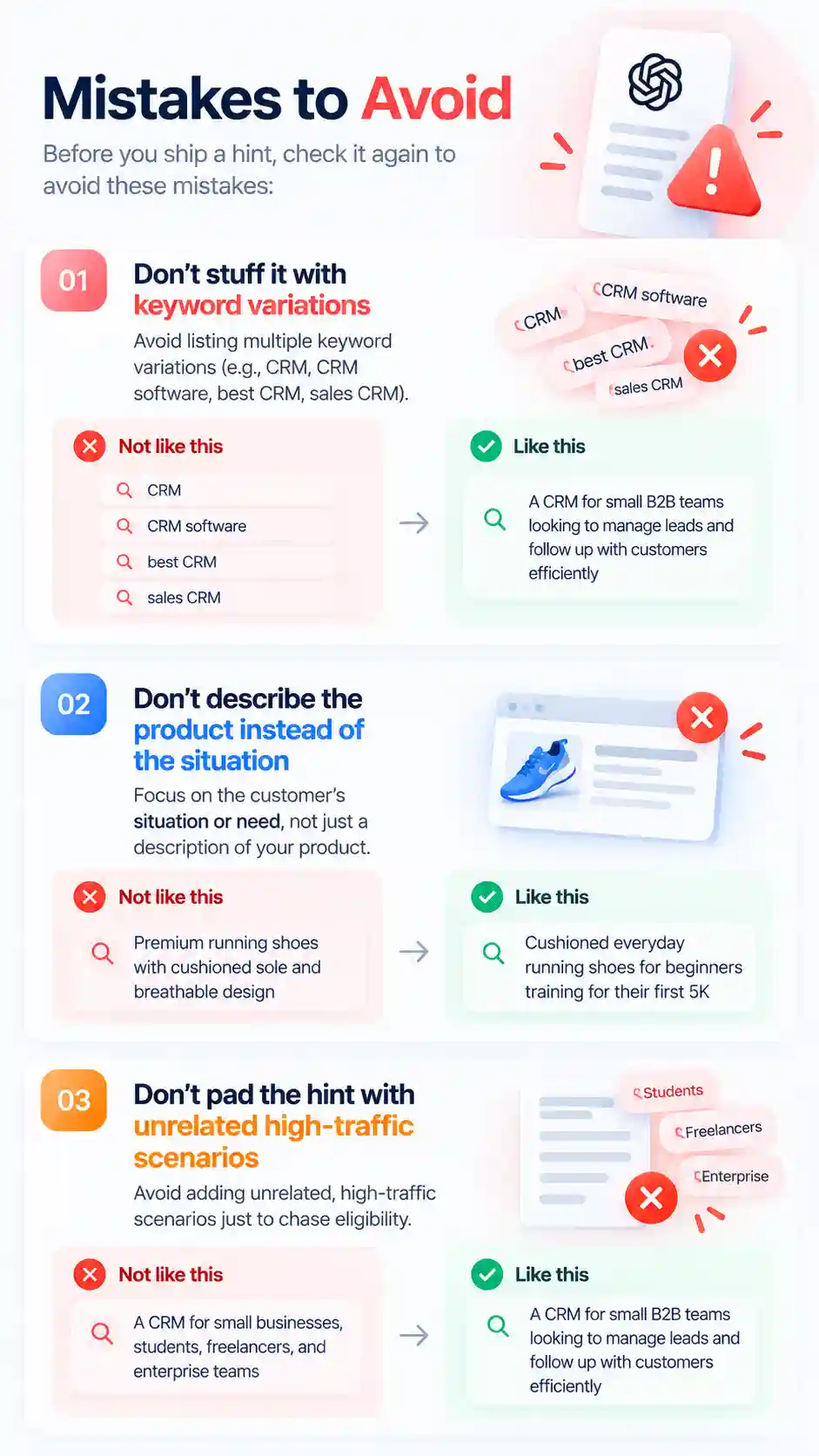
Before you ship a hint, check it again to avoid these mistakes:
- Don’t stuff it with keyword variations (e.g., CRM, CRM software, best CRM, sales CRM)
- Don’t describe the product instead of the situation
- Don’t pad the hint with unrelated high-traffic scenarios chasing eligibility
And don’t assume guaranteed ad delivery. A context hint can improve the odds of relevant eligibility, nothing more.
Get the Best of ChatGPT Ads with Blusteak
Anyone can copy a list of context hint examples. Writing ones that match how your real customers think is where most businesses fail. ChatGPT ads aren’t just about context hints; they also require clean creatives and convincing landing pages.
Blusteak has been building highly-converting campaigns around genuine customer intent. We create high-impact advertising strategies that connect your brand with the right audience.
Want to turn ChatGPT Ads into a powerful growth channel? Get in touch with Blusteak


)